
Blog
From Human Observation to Machine Perception in Poultry Farming

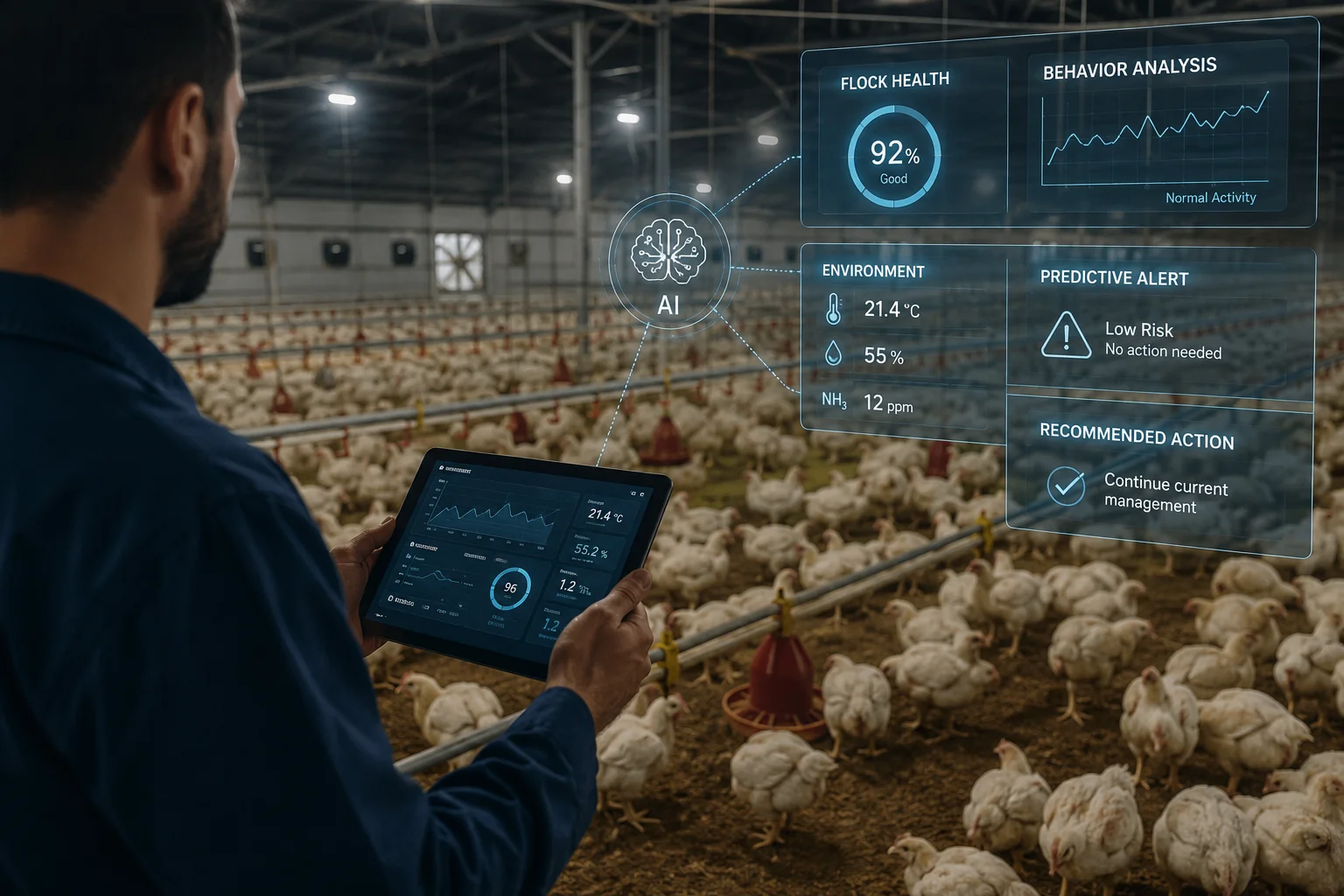
How Computer Vision and Artificial Intelligence Are Expanding the Way We Observe Flocks
Executive Summary
Poultry production has always depended on observation. Experienced farmers, flock managers and veterinarians learn to recognize changes in movement, distribution, feeding, drinking, posture and general flock behaviour that may indicate changing environmental, health or welfare conditions.
The challenge is scale and continuity.
A commercial poultry flock is a dynamic biological population. Thousands of birds interact with one another and with their environment continuously, while human observation necessarily occurs at selected moments.
Advances in computer vision, artificial intelligence and non-contact sensing are beginning to extend this observational capacity.
Machine perception refers to the ability of computational systems to interpret information collected from their environment and convert raw sensory input into useful representations of what is happening. In poultry farming, this may include measuring flock activity, movement, spatial distribution and selected behaviours from images or video.
This represents an important distinction. A camera records images. Computer vision extracts measurable information from those images. Machine perception aims to interpret those measurements within a meaningful representation of the observed environment.
Recent research shows substantial progress in automated poultry detection, tracking and behavioural measurement. At the same time, significant limitations remain, including occlusion, variable lighting, changing bird appearance, dense flock conditions, limited datasets and the challenge of validating algorithms across commercial farms.
The emerging opportunity is therefore not to replace human observation, but to complement it with continuous, quantitative evidence.
1. Observation Has Always Been Fundamental to Poultry Management
Experienced poultry professionals rarely evaluate a flock using a single number.
They observe how birds move.
They notice whether birds are evenly distributed.
They look for crowding around feeders or drinkers.
They observe resting patterns, posture, walking ability and interaction with the environment.
They listen to the flock.
They compare what they see today with what they expect for birds of a similar age and production stage.
This form of observation contains valuable contextual knowledge.
But it has an unavoidable limitation:
human observation is intermittent, while flock behaviour is continuous.
A barn walk provides an important snapshot of flock conditions. It cannot provide an uninterrupted record of how activity, movement or spatial organization changed throughout the previous hours.
This becomes increasingly relevant as flock sizes increase.
Changes can also be gradual.
A flock does not necessarily transition from normal to abnormal at a clearly identifiable moment. Activity may decline progressively. Distribution may become increasingly uneven. Time spent around resources may change. Walking patterns may deteriorate.
These changes may be difficult to recognize when observations are separated by hours.
This is one reason Precision Livestock Farming has increasingly focused on technologies capable of continuous and non-invasive observation.
2. What Is Machine Perception?
Machine perception is a well-established concept in artificial intelligence.
Broadly, it refers to the ability of a computational system to receive information from its surroundings through sensors and interpret that information in a useful way.
Machine perception can involve:
- computer vision;
- machine listening;
- environmental sensing;
- thermal imaging;
- depth sensing;
- other forms of digital measurement.
Research organizations working in machine perception describe it as the computational interpretation of images, sounds and other sensory information.
In poultry farming, machine perception should therefore not be understood simply as putting cameras inside a poultry house.
The distinction is important.
Sensing captures information.
Computer vision extracts information from visual data.
Perception attempts to construct a meaningful representation of what is occurring.
For example, a video is raw sensory information.
Detecting birds inside the video is a computer-vision task.
Tracking their movement over time provides additional information.
Quantifying whether flock activity is increasing, decreasing or changing spatially begins to create a higher-level representation of flock behaviour.
Machine perception is therefore concerned with the transition from raw observation toward measurable interpretation.
3. From Images to Measurable Flock Behaviour
A poultry house presents a particularly difficult environment for computer vision.
Unlike many industrial applications, birds are not stationary objects moving along predictable paths.
They constantly:
- move;
- rest;
- overlap;
- change orientation;
- cluster;
- separate;
- enter and leave camera views;
- partially obscure one another.
Their appearance also changes substantially throughout the production cycle.
Despite these challenges, research has progressed rapidly.
A 2026 review published in Poultry Science screened the recent literature on computer vision in precision poultry farming and identified 82 eligible studies examining applications including bird identification, behavioural detection, counting, tracking, health monitoring, spatial distribution and activity measurement.
The significance of this research is larger than automated bird counting.
Computer vision increasingly allows researchers to transform video into measurable behavioural variables.
These measurements can include:
Activity
How much movement occurs within a flock or among individual birds.
Locomotion
How birds move through space and how movement changes over time.
Distribution
How birds occupy different areas of the poultry house.
Resource-related behaviour
Patterns associated with feeder or drinker areas.
Resting and active periods
How behavioural states vary throughout the day.
Individual behaviours
Under controlled or appropriately validated conditions, systems may classify selected behaviours such as feeding, drinking, activity or inactivity.
These measurements convert what was once primarily qualitative observation into data that can be compared across time.
4. Behaviour Provides Information About the Biological State of the Flock
Behaviour is one of the ways animals respond to their biological and physical environment.
Birds modify their behaviour in response to many factors, including:
- temperature;
- lighting;
- age;
- feed availability;
- water availability;
- stocking conditions;
- social interaction;
- mobility;
- health;
- environmental disturbances.
For this reason, behavioural observation has long been important in animal science and welfare assessment.
Digital technologies do not change this biological principle.
They change the scale at which behaviour can potentially be measured.
Research has demonstrated several examples.
A 2025 experimental study evaluated automated measurement of flock activity in chickens exposed to fowl adenovirus. Quantified activity was associated with visual clinical scores, illustrating how changes in movement can contain biologically relevant information under experimental conditions. The authors nevertheless framed the method as a potential monitoring tool rather than a substitute for diagnosis.
Other research has examined activity changes under heat exposure. A 2025 Poultry Science study found that automatically derived broiler activity measures changed under different thermal conditions, while also demonstrating that activity was influenced by variables including bird age, diet, temperature and relative humidity.
This second point is particularly important.
Behaviour is informative, but it is rarely specific to one cause.
Reduced activity does not automatically mean disease.
Uneven distribution does not automatically mean environmental stress.
Changes around a feeder do not automatically indicate a feed-system problem.
Behaviour must be interpreted within biological and operational context.
5. Why Time Matters as Much as the Observation Itself
One of the most important advantages of automated observation is the ability to analyse change over time.
A single measurement of activity has limited meaning.
A trajectory of activity may be much more informative.
Consider three scenarios:
A flock has consistently low activity during its normal resting period.
A flock shows a sudden activity decline following a management event.
A flock shows a progressive reduction in daytime activity across several days.
All three may produce a similar activity measurement at one moment.
Their interpretation is very different.
This illustrates a fundamental principle of biological monitoring:
Context gives measurements meaning.
Important contextual variables may include:
- flock age;
- time of day;
- light and dark periods;
- previous behavioural patterns;
- environmental conditions;
- management events;
- recent health history.
Research published in 2026 using multi-view tracking of broilers similarly demonstrated that activity and feeder- and drinker-related behaviour varied across the production cycle and according to time of day and thermal conditions.
The implication is clear.
A useful behavioural measurement should not only answer:
How active is the flock?
It should increasingly help answer:
How does the current activity compare with what would normally be expected under comparable conditions?
6. From Individual Birds to Flock-Level Patterns
One of the distinctive challenges of poultry farming is scale.
Many Precision Livestock Farming technologies originally developed for dairy cattle, pigs or other livestock focus heavily on individual-animal monitoring.
Commercial poultry production often requires another perspective:
the flock itself can become an important unit of observation.
Individual-level information remains valuable, but population-level patterns may reveal information that is difficult to identify from isolated birds.
Examples include:
- flock-wide activity;
- clustering;
- spatial density;
- distribution around resources;
- coordinated movement;
- changes across different barn zones.
Research has increasingly explored both levels.
A 2024 study in Computers and Electronics in Agriculture used computer vision and trajectory analysis to classify commercial broiler movement into different activity patterns. The researchers demonstrated the potential for detecting short-term behavioural changes while also emphasizing that additional development and validation would be necessary for longer-term welfare interpretation.
Another 2024 study developed machine-learning approaches for detecting, tracking and classifying feeding, drinking, active and inactive behaviours among group-housed broilers.
Together, these studies demonstrate an important shift:
poultry computer vision is moving beyond recognizing the presence of birds toward quantifying how birds behave individually and collectively.
7. Movement Can Become a Quantitative Welfare Indicator
Walking ability and locomotion are important components of broiler welfare.
Traditionally, these characteristics have often been evaluated through direct observation or gait assessment.
Computer vision creates possibilities for more continuous assessment.
Researchers have investigated methods including optical flow, tracking and movement analysis to quantify aspects of poultry locomotion without physically attaching devices to every bird.
A review discussing active walking in broiler chickens argued that sustained, unimpaired walking is biologically meaningful for welfare and represents a promising candidate for automated assessment.
Other work has examined automated measures of activity, distribution and walking ability under commercial conditions, while emphasizing the need for further validation across ages and welfare states.
This illustrates both the promise and the correct scientific caution required in this field.
Automated behaviour measurements may contribute valuable welfare evidence.
They should not automatically be treated as complete welfare assessments.
Animal welfare is multidimensional.
No single movement index can capture every aspect of an animal’s physical and behavioural state.
8. Computer Vision Is Not the Same as Biological Understanding
This distinction is essential.
Modern computer vision can perform increasingly sophisticated tasks.
But successful detection or classification does not necessarily mean that a system understands the biological cause of what it observes.
Suppose a system detects that birds have become more densely clustered.
Several explanations may be possible:
- thermal conditions;
- airflow;
- lighting;
- equipment configuration;
- resource availability;
- disturbance;
- normal behaviour.
The visual observation may be accurate while the biological interpretation remains uncertain.
This is one of the most important boundaries in agricultural AI.
Recognition is not diagnosis.
Correlation is not causation.
An anomaly is not automatically a problem.
Responsible use of machine perception therefore requires separating what was directly observed from what is inferred from that observation.
This distinction becomes even more important when technology is used in health or welfare contexts.
9. Why Multiple Forms of Evidence Matter
Animals respond to their environment through interconnected biological processes.
Visual behaviour represents only one part of that system.
Other forms of evidence may include:
- environmental conditions;
- sound;
- production data;
- feed and water consumption;
- body weight;
- mortality;
- clinical observations.
Recent reviews of poultry technologies increasingly emphasize the potential value of integrating multiple sensing modalities rather than relying on one source of information.
The scientific rationale is straightforward.
Different measurements answer different questions.
Environmental sensing describes conditions around the flock.
Computer vision describes visible responses and behaviours.
Production records describe outcomes.
Clinical observations provide additional biological information.
When independent evidence sources change simultaneously, interpretation may become stronger.
However, integration also introduces additional challenges.
Sensors may operate at different sampling rates.
Measurements may be missing.
Timing may be misaligned.
Signals may contradict one another.
More data therefore does not automatically mean better understanding.
The quality and context of the evidence remain fundamental.
10. Human Observation and Machine Perception Are Complementary
The development of machine perception is sometimes described as a replacement for human observation.
That framing is misleading.
Humans and machines have different strengths.
Experienced poultry professionals can interpret subtle contextual information that may not be represented in digital data.
They understand:
- recent management events;
- building characteristics;
- equipment history;
- unusual circumstances;
- clinical context;
- practical constraints.
Machines offer another set of advantages:
- continuous observation;
- repeatable measurement;
- analysis across long periods;
- measurement of large volumes of video;
- quantitative comparison between observations.
The strongest future model is therefore complementary.
Humans provide expertise, context and judgment.
Automated perception provides continuity and measurement.
This relationship is particularly important because biological interpretation requires more than pattern recognition.
A system may identify a pattern worth investigating.
Determining its significance may still require an experienced farm manager, animal scientist or veterinarian.
11. Why Machine Perception Matters for Canadian Poultry Production
Canada has a significant commercial poultry sector.
According to Agriculture and Agri-Food Canada, 2,834 regulated chicken producers produced approximately 1.4 billion kilograms of chicken in 2025, with Ontario and Quebec accounting for about 61% of production.
At this scale, consistent observation of flock conditions is operationally important.
Canada also maintains established animal-care frameworks.
The National Farm Animal Care Council’s Code of Practice for hatching eggs, breeders, chickens and turkeys provides nationally developed requirements and recommended practices for poultry care. The current Code, released in 2016, is undergoing revision, with a public comment period planned for September–October 2026 and completion projected for September 2027.
Digital observation technologies do not replace these standards or professional responsibilities.
Their potential contribution is different:
they may provide additional objective and longitudinal evidence about flock behaviour and conditions.
This could become increasingly valuable in production environments where continuous observation by people is impossible.
12. The Commercial Farm Is Much Harder Than the Research Dataset
One of the greatest risks in agricultural AI is assuming that strong experimental results automatically translate into reliable commercial performance.
They do not.
Commercial poultry houses contain many sources of variability:
- high stocking density;
- occlusion;
- dust;
- changing lighting;
- different camera perspectives;
- moving equipment;
- changing bird size;
- seasonal conditions;
- differences between houses;
- differences between farms.
Research datasets may capture only part of this variability.
A 2025 review of open-access poultry computer-vision datasets identified only 20 qualifying public image and video datasets and highlighted limitations in dataset scale, consistency and standardized evaluation.
A broader 2026 review of 191 computer-vision studies across livestock and poultry similarly concluded that behaviour monitoring and identification dominate the research literature, while evidence of biological welfare validation and real-world productivity impact remains more limited. Data openness and reproducibility also remain important barriers.
These limitations should not be interpreted as evidence that computer vision lacks value.
They reveal the next scientific challenge:
moving from technical demonstrations toward robust biological and commercial validation.
13. Accuracy Alone Is Not Enough
Computer-vision research frequently reports metrics such as:
- precision;
- recall;
- detection accuracy;
- tracking performance;
- classification accuracy.
These measurements are necessary.
But agricultural applications require additional questions.
Does the model remain reliable when birds grow?
Does it work under different lighting?
Does it perform similarly in another poultry house?
Can it recognize conditions it has not seen before?
Does the measured behaviour have biological significance?
Does the information improve farm observation?
A technically impressive model may still have limited operational value if the measured variable does not represent something meaningful.
For this reason, the future of poultry machine perception will depend increasingly on collaboration between:
- computer scientists;
- poultry scientists;
- veterinarians;
- animal behaviour researchers;
- engineers;
- commercial producers.
The problem is not purely computational.
It is biological and operational as well.
14. The Future of Poultry Observation
The history of poultry management has been dominated by episodic observation.
A person enters a house, observes the flock, identifies visible conditions and makes a professional judgment.
Digital technologies are gradually adding another layer:
continuous quantitative observation.
The two should not be considered competitors.
Together, they can provide a richer representation of flock conditions than either approach alone.
The long-term scientific direction is becoming increasingly clear.
Computer vision is moving from:
images → detection → tracking → behaviour measurement → contextual interpretation
At the same time, research is becoming more cautious about what these systems can legitimately claim.
Real progress will require technologies that are not merely accurate in controlled datasets but robust across real farms, biologically meaningful and transparent about uncertainty.
This is the deeper significance of machine perception in poultry farming.
The objective is not simply to teach computers to recognize chickens.
It is to develop better ways of measuring how flocks change over time.
Conclusion
Human observation will remain fundamental to poultry farming.
Experienced farmers, farm managers and veterinarians bring contextual knowledge and biological judgment that cannot be reduced to a camera feed or a single algorithm.
But human observation has physical limits.
No person can continuously observe every part of a poultry house, every hour of the day.
Machine perception offers a complementary capability.
By converting images, video and other sensory information into quantitative measurements of movement, behaviour and spatial patterns, artificial intelligence can expand the observational capacity of poultry production.
The important transition is therefore not from humans to machines.
It is from periodic observation to continuous evidence.
Computer vision research has already demonstrated that aspects of activity, movement, distribution and selected behaviours can be measured automatically. The next challenge is ensuring that those measurements remain reliable across commercial environments and are interpreted with appropriate biological context.
The future of poultry observation will likely combine two forms of intelligence:
the contextual judgment of experienced people and the continuous measurement capabilities of machines.
That combination may ultimately allow the poultry sector to observe flocks with greater continuity, objectivity and biological insight than either could provide alone.
Frequently Asked Questions
What is machine perception in poultry farming?
Machine perception in poultry farming is the use of computational systems to interpret information collected from cameras or other sensors and derive measurable representations of birds, behaviours or environmental conditions.
Is machine perception the same as computer vision?
No. Computer vision focuses primarily on extracting information from images and video. Machine perception is a broader concept that can include vision, sound and other sensory information used to interpret an environment.
How can computer vision be used in poultry farming?
Research has explored applications including bird detection, counting, tracking, activity measurement, spatial distribution, locomotion, feeding and drinking behaviour, welfare assessment and selected health-related observations.
Can AI understand chicken behaviour?
AI can detect and quantify selected behavioural patterns when appropriate models and data are available. However, identifying a behaviour does not necessarily explain its biological cause.
Can computer vision detect poultry disease?
Research has explored associations between visual or behavioural changes and health conditions, but computer vision alone should not be considered a universal diagnostic tool. Disease diagnosis may require clinical examination, necropsy, laboratory testing and veterinary judgment.
Why is poultry behaviour important?
Behaviour reflects how birds interact with their environment and can provide information relevant to health, welfare and management. However, behaviour is influenced by many factors and must be interpreted in context.
Can AI replace poultry farm workers or veterinarians?
Current evidence does not support that framing. Automated systems are better viewed as tools that can extend observation and measurement while humans retain responsibility for contextual interpretation and professional decisions.
What are the main challenges of computer vision in poultry houses?
Important challenges include bird overlap, high stocking density, dust, changing lighting, differences between farms, changing bird appearance, limited datasets and difficulty validating algorithms under diverse commercial conditions.
Why is continuous monitoring useful?
Continuous monitoring can reveal how flock behaviour changes between human observations and can create quantitative records that allow patterns to be compared across time.
What is the future of machine perception in poultry farming?
The research direction is moving toward more robust behavioural measurement, multimodal sensing, improved commercial validation and stronger integration between artificial intelligence and animal science.
References
- Paneru B, Dhungana A, Dahal S, et al. Computer vision models for precision poultry farming: A narrative review of behavioral and welfare monitoring studies. Poultry Science. 2026;105(7):106887. DOI: 10.1016/j.psj.2026.106887.
- Yang X, Bist RB, Paneru B, et al. Computer Vision-Based cybernetics systems for promoting modern poultry farming: A critical review. Computers and Electronics in Agriculture. 2024. DOI: 10.1016/j.compag.2024.109339.
- Campbell M, Miller P, Díaz-Chito K, et al. A computer vision approach to monitor activity in commercial broiler chickens using trajectory-based clustering analysis. Computers and Electronics in Agriculture. 2024;217:108591. DOI: 10.1016/j.compag.2023.108591.
- Merenda VR, Bodempudi VUC, Pairis-Garcia MD, Li G. Development and validation of machine-learning models for monitoring individual behaviors in group-housed broiler chickens. Poultry Science. 2024;103(12):104374. DOI: 10.1016/j.psj.2024.104374.
- Automatic monitoring of activity intensity in a chicken flock using a computer vision-based background image subtraction technique: An experimental infection study with fowl adenovirus. Smart Agricultural Technology. 2025;10:100821. DOI: 10.1016/j.atech.2025.100821.
- Automatic analysis of high, medium, and low activities of broilers with heat stress operations via image processing and machine learning. Poultry Science. 2025;104(4):104954. DOI: 10.1016/j.psj.2025.104954.
- A survey of open-access datasets for computer vision in precision poultry farming. Poultry Science. 2025;104(2):104784.
- Agriculture and Agri-Food Canada. Canada’s Poultry and Egg Industry Profile. Updated June 24, 2026.
- National Farm Animal Care Council. Code of Practice for the Care and Handling of Hatching Eggs, Breeders, Chickens and Turkeys. Code currently under revision.