Introduction: The Silent Limitation of Monitoring Systems
For decades, poultry farming technology has been built around a simple paradigm:
“Observe what is happening.”
Cameras, sensors, dashboards, and alarms all share the same limitation: they describe the present state of the flock, not its future trajectory.
But modern poultry production no longer suffers from lack of data — it suffers from lack of interpretation and actionability.
This is where the transition begins:
From Monitoring → To Decision Intelligence
What is Poultry Decision Intelligence?
Poultry Decision Intelligence is the integration of:
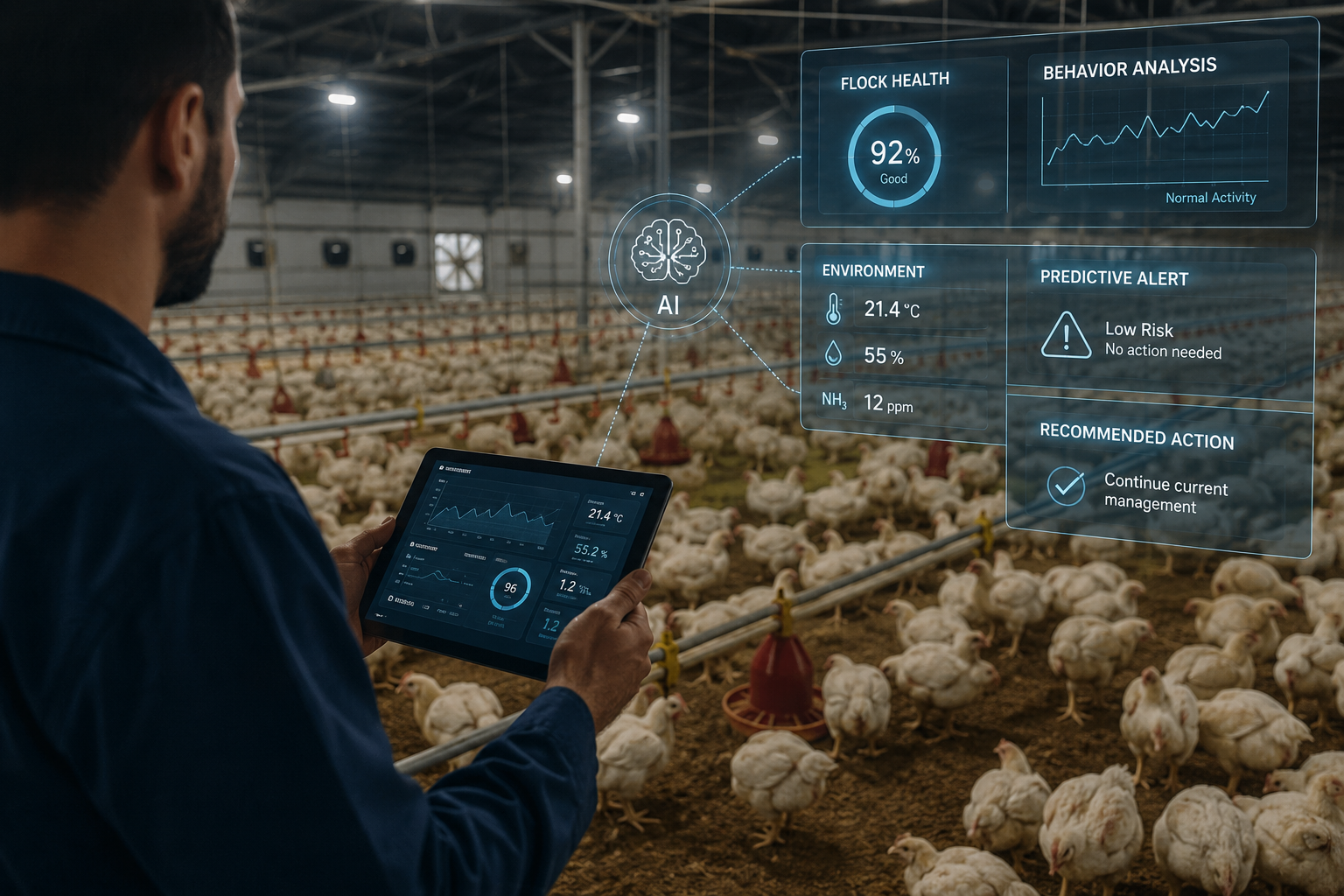
- Multimodal AI (vision + sensor + environmental data)
- Predictive modeling of flock behavior
- Causal inference from production signals
- Automated recommendation systems
Instead of answering:
“What is happening in the barn?”
It answers:
“What will happen next — and what should we do now?”
The Structural Shift: Three Layers of Intelligence
1. Perception Layer (Machine Observation)
- Computer vision detects:
- Movement patterns
- Feeding behavior
- Mortality signals
- Environmental sensors capture:
- Temperature
- Humidity
- Ammonia levels
Output: Raw structured data
2. Interpretation Layer (AI Understanding)
- Behavioral clustering
- Anomaly detection
- Health risk estimation
- Growth trajectory modeling
Output: Meaningful biological signals
3. Decision Layer (Action Intelligence)
- Adjust ventilation automatically
- Modify feeding schedules
- Flag veterinary intervention
- Predict outbreak probability
Output: Actionable decisions
Why Monitoring Alone Fails in Modern Poultry Systems
According to agricultural digitalization studies referenced by FAO, most farms already generate high-frequency data, but:
- <30% is actively used in decision-making
- Most systems rely on human interpretation bottlenecks
- Reactive response leads to delayed intervention
The result is a structural inefficiency:
Data abundance, decision scarcity.
The Role of AI in Transforming Poultry Systems
Modern AI systems — especially vision-based architectures like YOLO and multimodal transformers — introduce:
1. Temporal Understanding
Tracking how flock behavior evolves over time
2. Predictive Health Modeling
Detecting disease probability before visible symptoms
3. Behavioral Intelligence
Understanding stress, discomfort, and welfare indicators
From Data to Biology: A New Scientific Layer
Traditional systems treat poultry as:
“A population of measurable units”
Decision Intelligence treats poultry as:
“A dynamic biological system with emergent behavior”
This shift aligns with modern research in:
- Poultry Science Journal
- Precision Livestock Farming frameworks
- EFSA animal welfare models
Industry Implications
1. Farm Operations
- Reduced mortality rates
- Optimized feed conversion ratio (FCR)
- Early intervention systems
2. Veterinary Systems
- Shift from reactive treatment → predictive prevention
3. Supply Chain
- More stable production forecasting
- Reduced volatility in protein CleverAvian Positioning Insight
CleverAvian is not building a monitoring system.
It is building:
An AI Decision Intelligence Platform for Poultry Farming
This means:
- Not just seeing birds
- But understanding flock behavior
- Not just detecting disease
- But forecasting risk trajectories
- Not just collecting data
- But generating decisions